
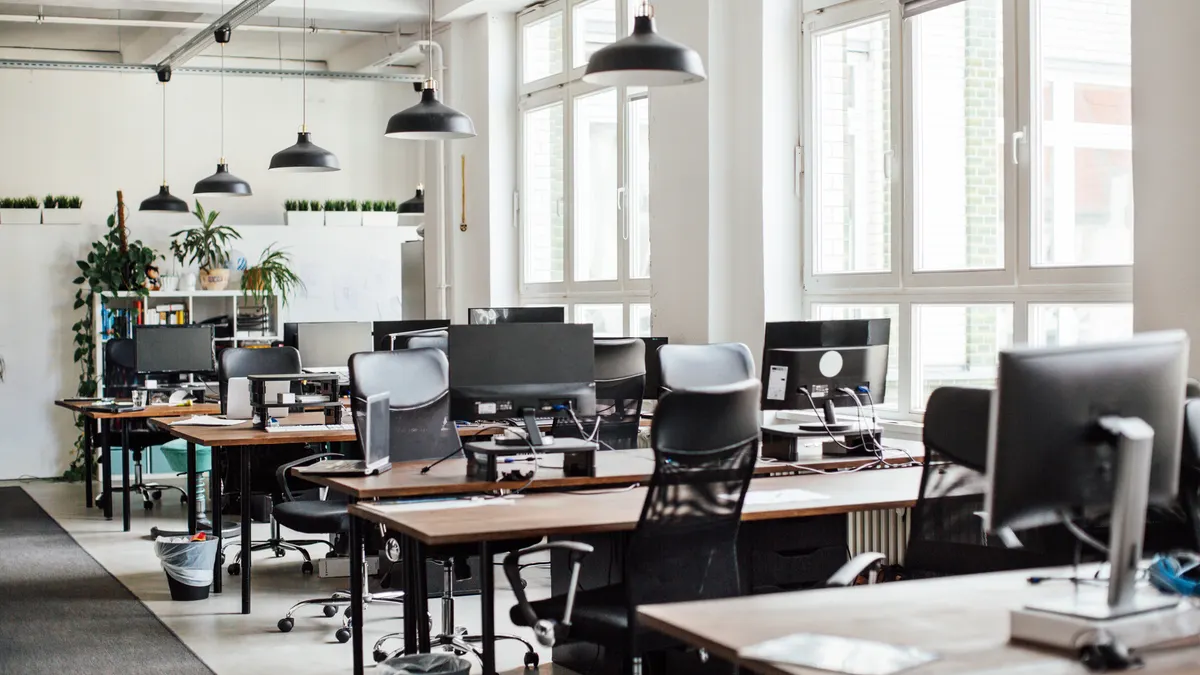

The tech workplaces across North America, once renowned for their innovative and amenity-rich designs, are now grappling with the aftermath of the pandemic’s impact on work patterns and flexible schedules. This underutilization has resulted in up to $40 million wasted annually on rent costs for spaces that are not fully used.
Daniel Davis, head of research at Hassell, noted that tech companies, which were once leaders in workplace design, now face challenges as they adjust to hybrid and remote work models adopted during the pandemic. Many offices are now either sitting unused or struggling to accommodate new work patterns effectively.
Before the pandemic, tech companies heavily favored open-plan offices, but the shift to hybrid work has altered how these spaces are used. Meeting rooms now often serve as quiet spots for video calls, and private offices are utilized about 36% of the time.
The report highlighted that employees tend to come into the office primarily for social interactions. In workplaces where employees have the flexibility to choose their work location, approximately half of their in-office time is spent in meeting rooms with others. In comparison, workplaces with mandatory two or three-day in-office policies see lower utilization of meeting spaces.
Interestingly, the report also found that return-to-office policies may not significantly impact office utilization rates as initially anticipated. Transitioning from flexible to mandatory hybrid policies saw an increase in peak daily utilization from 29% to 46%, suggesting that hybrid policies may not be uniformly enforced or adhered to.
To optimize workplace design and utilization, Hassell and Density recommended several actionable strategies. These include adapting designs to meet the evolving needs of hybrid work, maximizing space efficiency to reduce costs and environmental impact, and fostering a flexible and collaborative culture that accommodates varying work needs and group sizes.
The findings underscore the importance for businesses to redesign offices that bridge the gap between home and office environments, as highlighted in a Cisco report. Both employers and employees expressed a desire for improved technology infrastructure to support hybrid work, along with ergonomic layouts, sustainable features, and amenities that promote health and wellness. These efforts are crucial as organizations navigate the ongoing evolution of work dynamics in the post-pandemic era.